FOOH and luxury advertising: dreaming in the street
On 5 April 2023, three Jacquemus Le Bambino bags drove down a Paris street like little cars. Eight seconds on Instagram, and a crowd of viewers unable to tell whether it was real. Nobody asked how. Everybody asked if. That is the whole grammar of FOOH, fake out of home: a billboard that never existed, in a city that very much does.
A billboard that was never put up
FOOH means compositing computer-generated imagery into real street footage: an outsized object in the middle of a road, a façade that comes alive, a shop window that defies gravity. Nothing is installed. No tarpaulin, no scaffolding, no street permit. The billboard exists only in its film, and the film exists only on social media, where it travels like the memory of an event nobody lived.
The phenomenon took off in 2023, and fashion houses led the way: Jacquemus, Isabel Marant, Alexander Wang. Behind the Jacquemus bags on wheels is Ian Padgham, a Bordeaux-based artist who went on to put giant eyelashes on London tube trains and buses for Maybelline Sky High mascara. Luxury opened the door. Mass brands rushed through it.
Luxury has always staged the impossible
Nothing new, really. Department store Christmas windows, runway shows built for twenty minutes inside cathedral-sized sets, giant bottles wrapping façades under renovation: luxury has never sold an object on its own. It sells the setting around it, and the distance between that setting and everyday life. FOOH extends this tradition of the marvellous with a new tool: the whole city becomes a stage.
Jacquemus understood this perfectly. Just before the bags on wheels, the house ran a very real pop-up at Galeries Lafayette, filled with oversized objects, including a giant Bambino. The real, then the fake. Each feeds the other, and it is precisely in that in-between that the image becomes desirable.
The grammar of the believable fake
What makes a FOOH convincing is never the 3D object. It is everything around it. Ian Padgham describes his work in three stages: shoot so the scene can be rebuilt in 3D, integrate the elements by matching light, shadows and reflections, then spend hours erasing every detail that would give the trick away. I recognise that protocol exactly. The spectacular part is quick; the invisible part takes everything else.
In practice: precise camera tracking, the real light of the hour of the shoot rebuilt as an HDRI, contact shadows biting into the pavement, a reflection on wet cobblestones, the grain and compression of a phone, a passer-by who does not look up. A delicious paradox for a luxury art director: to be believed, the image has to give up part of its perfection. Too clean, and it becomes an advert again. The render engine matters too, as I explain in my comparison of 3D render engines: precious metal does not behave like grained leather under a streetlight.
Then there is rhythm. A successful FOOH first establishes reality, a few seconds of an ordinary street shot vertically, then lets the impossible emerge. If the reveal comes too early, doubt has no time to take root. And without doubt, there is no magic.
A panther, a night, a street corner
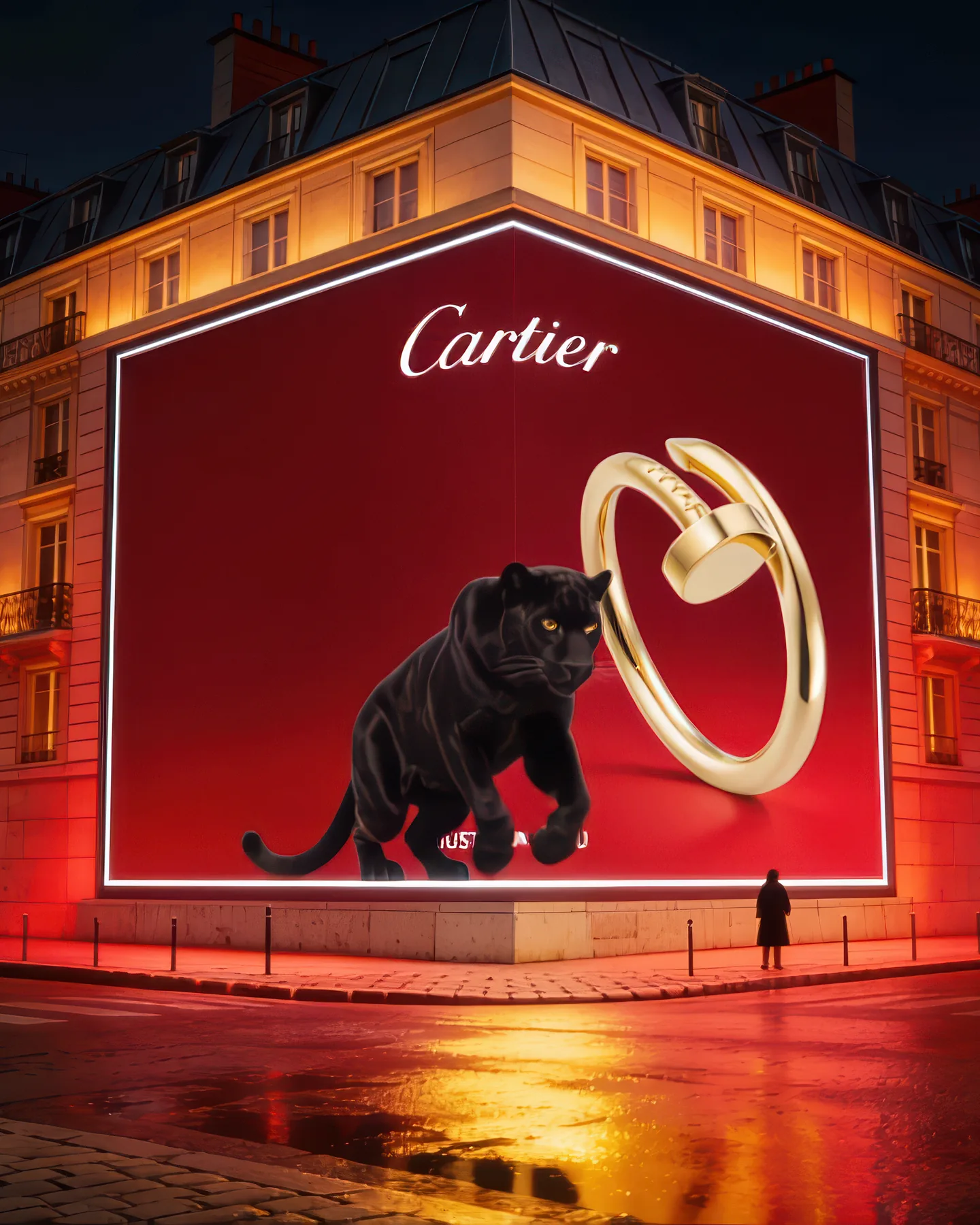
For a personal exploration, I imagined an anamorphic billboard for Cartier on the corner of a Haussmann building. A black panther leaps out of a red screen next to the Juste un Clou bracelet; the wet cobblestones carry the light all the way to the foreground; a single tiny figure in a black coat gives the scale. This is not a commission from the house. It is an exercise: finding out how far FOOH can go without losing the restraint that defines luxury.
Every choice points that way. Night, because the city falls silent and the screen becomes the only light source: the light tells the story. A single passer-by, because a crowd would turn the image into an event, while one figure turns it into an encounter. And the panther, because it is the emblem of the house: spectacle is only worth something when it serves a symbol people already love. Same logic in my Playground, where a lipstick floats down by parachute over the rooftops of Paris at sunset, the Eiffel Tower as a counterpoint. The object is impossible; the light has to be exact.
The real risk: fatigue
In three years, FOOH has become a genre with its own clichés: the giant object in the middle of the street, the façade that opens, the transformed bus. Generative AI lowers the cost even further, and feeds have filled up with interchangeable stunts. Maybelline said it as early as 2023: the day the format became expected, the brand would move on. When anyone can make a giant handbag drive, the giant handbag no longer says anything.
Luxury cannot play the game of one-upmanship. Its strength lies elsewhere: in the idea, the material, the light. Loewe showed it by melting its Squeeze bag into a shower of red beads that reassemble in mid-air. Not a matter of size: a metaphor for craftsmanship. The impossible in the service of an artisan's gesture.
Finally, there is the question of trust. A house lives on the belief people place in it. FOOH plays with doubt; it must never abuse it. Owning the fiction, in the caption or in the tone, does not break the spell: a magic trick is no less beautiful because you know it is a trick.
Doubt is an emotion. A lie would be a lapse in taste.
Dreaming in the street
FOOH is not the future of out-of-home. It is a new theatre, with its own rules: the idea before the scale, light before spectacle, the city as a partner rather than a backdrop. Done well, it gives luxury what it has always been after: a moment when everyday life tips over, when you catch yourself looking at a familiar street as if for the first time.
That tipping point is what I look for in every art direction and 3D motion design project. Not the biggest. The most precise.
- 01Creative Review - The rise of fake advertising (2024)[ www.creativereview.co.uk ]
- 02PAPER - How Jacquemus' Viral Bags-On-Wheels Stopped Traffic (2023)[ www.papermag.com ]
- 03Modern Retail - What Maybelline's 'faux OOH' ads say about the future of advertising (2023)[ www.modernretail.co ]
- 04Gulf Today - Jacquemus giant bags zooming through Paris (2023)[ gulftoday.ae ]
- 05FOOH.com - Loewe Squeeze bag transformation[ fooh.com ]
Looking for a trusted art director and motion designer for your project?