High Jewellery and 3D Animation: Staging Light as if It Were Matter
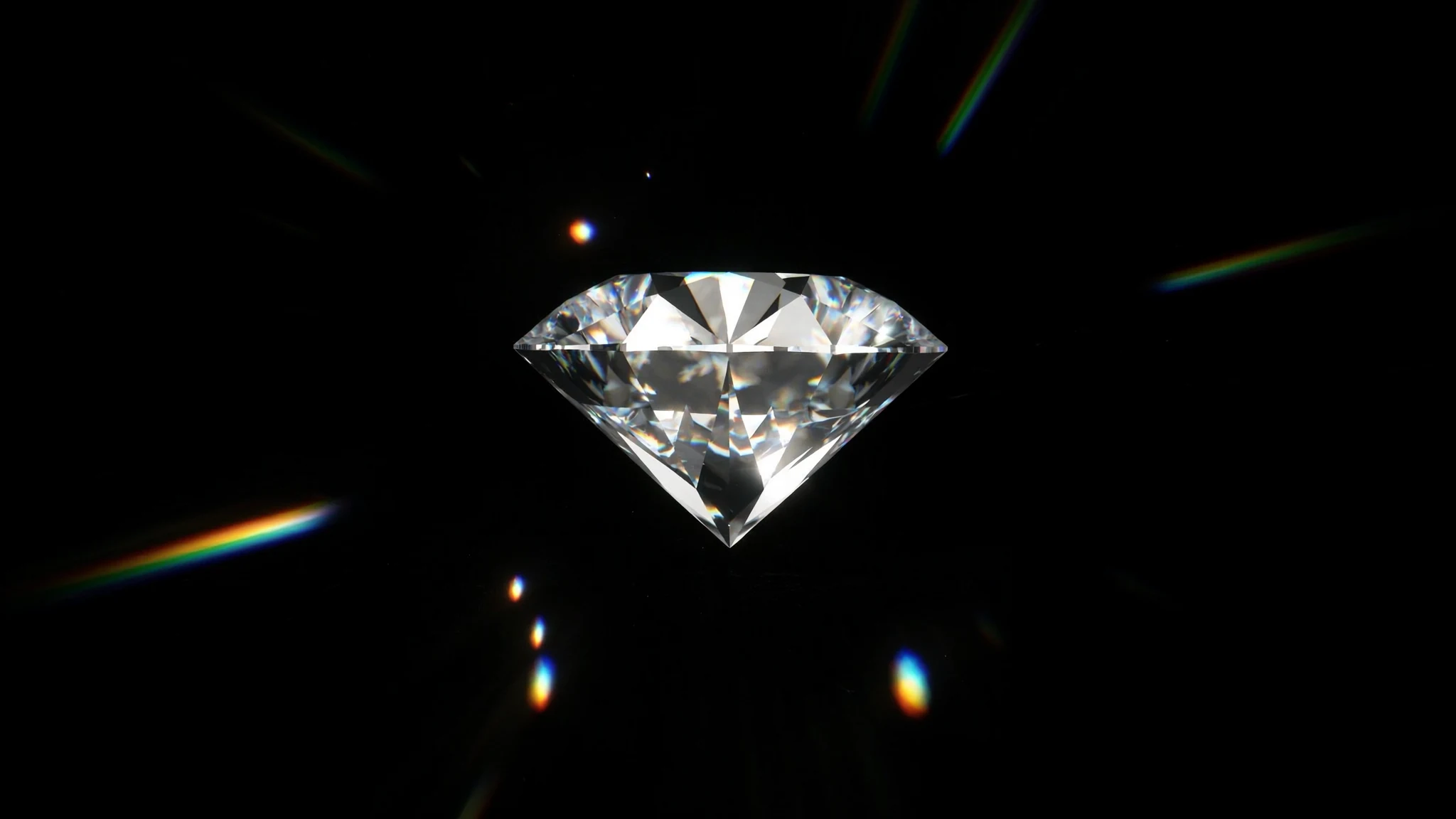
A brilliant-cut diamond has 57 facets. Each is an optical surface that refracts, reflects, disperses and absorbs light differently depending on the angle of incidence. Photographing that properly is already a feat. Animating it while respecting the physical laws that give it its value is what 3D rendering makes possible — and nothing else does.
Optics as the ultimate challenge
Diamond has a refractive index of 2.42 — one of the highest among natural materials, which explains why it captures and returns light in a way nothing else can imitate. Sapphire, depending on its colour, shows birefringence (it splits a light ray in two). Emerald, with its characteristic inclusions (the "jardin"), absorbs differently depending on wavelength. These properties are not details. They are the optical identity of each stone, and shaders must simulate them with physical accuracy if the render is to be credible to a jeweller or a client used to handling real stones.
Arnold has a dedicated gemstone shader implementing Sellmeier dispersion models (the equations that mathematically describe how the refractive index varies with wavelength). V-Ray has its own gem system with control over birefringence and selective absorption. This level of optical precision is not technical vanity: a house like Van Cleef & Arpels can immediately tell whether the reflections of an emerald in a render were computed with the right parameters or not.
The dramaturgy of light in jewellery
Light in 3D jewellery is never improvised. It is designed like a theatrical staging: every source has a narrative role. Grazing light reveals the surface textures of the metal — the grain of sandblasting, the line between polished and brushed, the precision of a claw setting. Soft, enveloping light belongs to organic materials: mother-of-pearl, coral, opal, ivory. These optical laws and complex reflections also pair with the techniques of fluid simulation for fragrance. Hard directional light belongs to diamond: it produces caustics, those projections of dispersed light onto surrounding surfaces that are the visual signature of a true quality stone.
Slow movement is a signal of value. There is no written rule, but a shared convention across all high-end jewellery communication: an object that spins fast communicates the ordinary. An object whose reveal takes eight seconds to make a half-turn communicates the rare. It is one of the structuring creative choices I develop as a specialist in luxury art direction. The timing of a high jewellery 3D animation is information in itself, just as coded as the typography chosen for the house's logo.
Proprietary metal colours and colour fidelity
Every great jewellery house has its own proprietary metal alloys. Patek Philippe's Sedna rose gold is not standard 18-carat rose gold. Nor is Rolex's Everose gold. These nuances are not in standard shader libraries: they have to be recreated empirically, calibrating the metal shader from physical samples or photographic references validated by the house. A freelancer who delivers a render with the wrong shade of rose gold will not be called back.
Managing colour spaces across the whole pipeline — from modelling to final comp — is a critical and often underestimated skill. Working in ACEScg for rendering, converting correctly to the house's output profile (often sRGB with proprietary adjustments for presentation screens), knowing the difference between what you see on your calibrated monitor and what the house will see on its boardroom screen: that is professional rigour in 3D jewellery.
- 01Gemological Institute of America (GIA) - Gem Optics[ www.gia.edu ]
- 02Luxion KeyShot Specialized Jewelry Rendering Pipeline[ www.keyshot.com ]
- 03OTOY OctaneRender GPU-accelerated Raytracer[ www.otoy.com ]
Looking for a trusted art director and motion designer for your project?