Luxury Watchmaking 3D Rendering: When Mechanics Become Spectacle
A million-euro watch on a white background. For decades, that was watchmaking communication. Clean, sober, flawless — and completely beside the point. 3D motion design changed the rules. Not to make things pretty. To finally say what photography could not.
The problem nobody puts into words
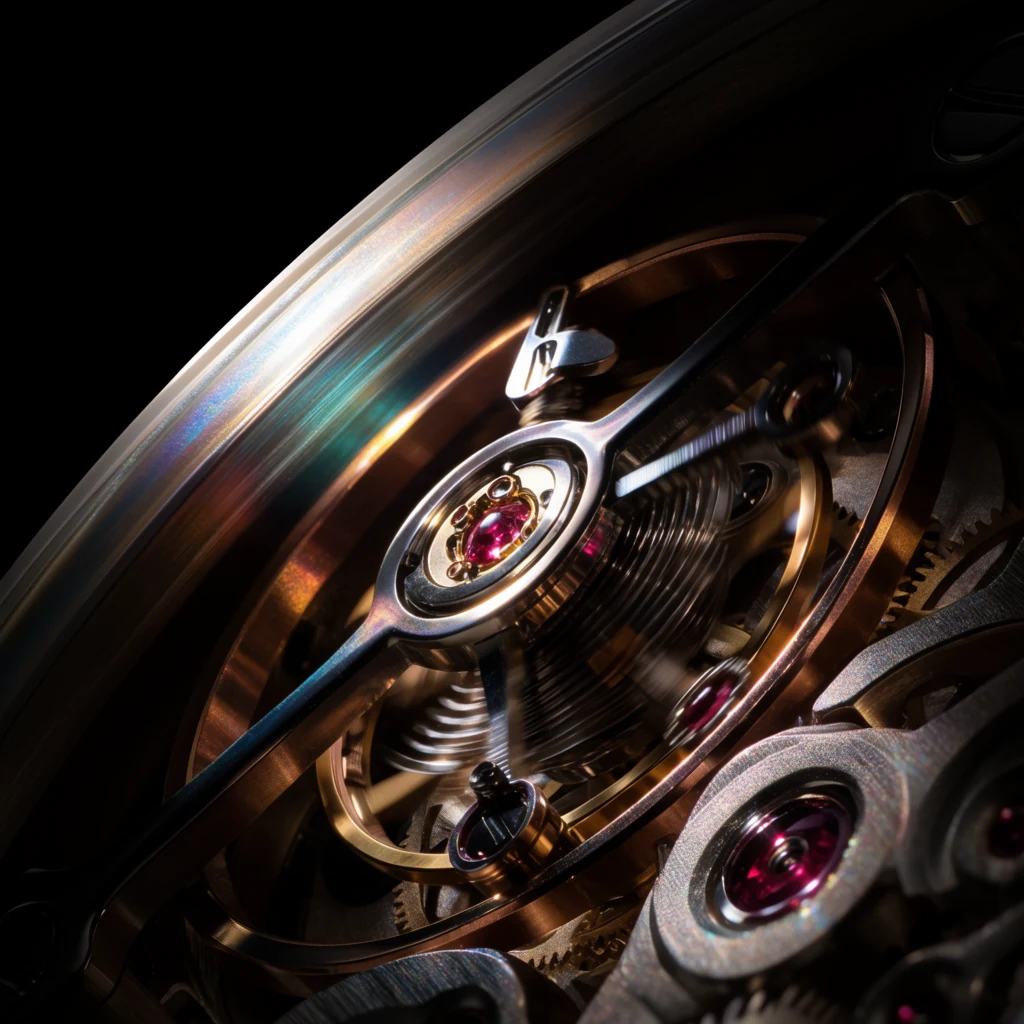
Here is what watchmaking briefs never tell you: the photograph of a manufacture calibre, however good, is fundamentally a lie. It freezes what is alive. It flattens what is three-dimensional. It silences what is, in the client's mind, a mechanical score played at 28,800 vibrations per hour.
Haute Horlogerie sells an idea: humanity's absolute mastery of time. Every bridge, every wheel, every jewel is a philosophical argument as much as a functional component. To understand that, you have to see the parts move. Not a photo retouched in Capture One, but a 3D motion design render that respects the laws of optics as scrupulously as the master watchmaker respected those of physics.
Path tracing, caustics and the existential crisis of DAMs
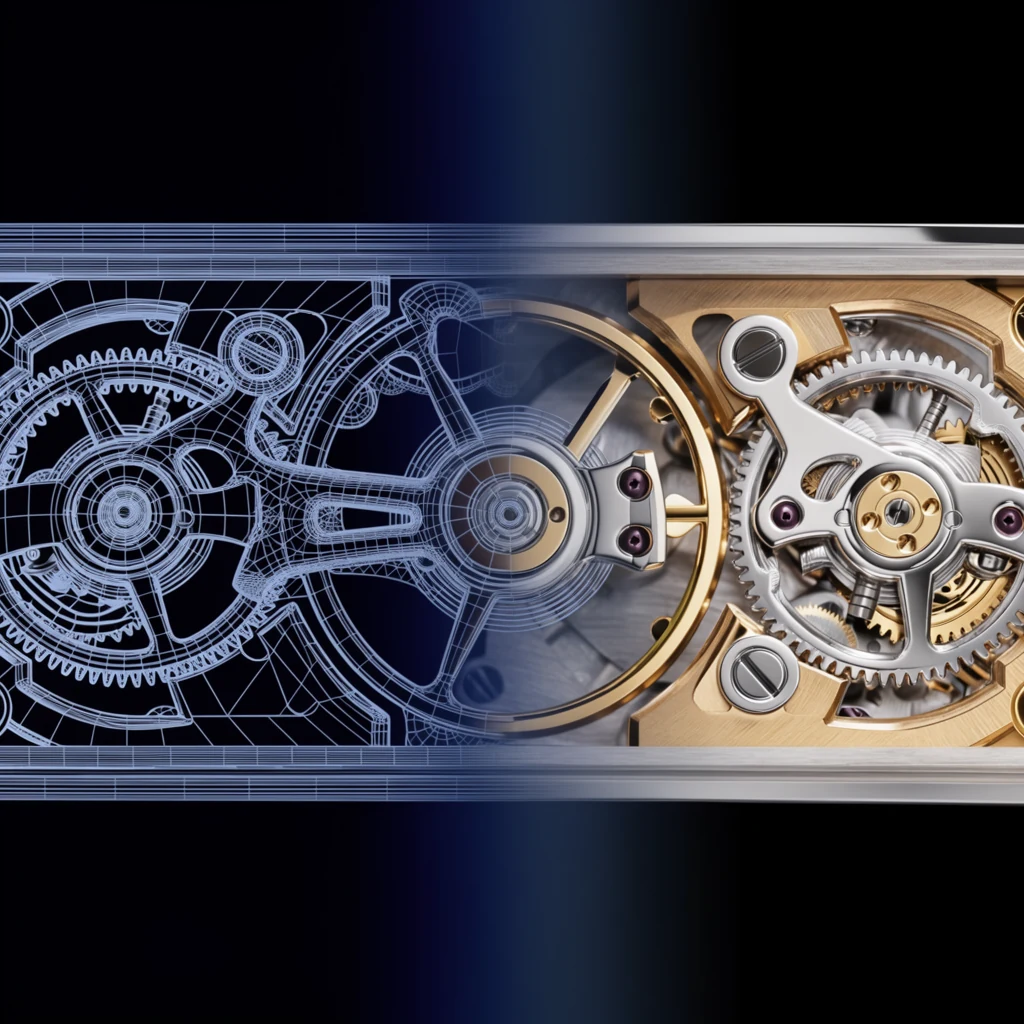
The choice of render engine is not anecdotal. For watchmaking, it is structural. Arnold and V-Ray are the references for unbiased path tracing: they compute with physical accuracy the light caustics passing through a sapphire crystal, the complex reflections alternating polished and brushed finishes on a steel bracelet, the translucency of a grand feu enamel dial. This rigour is crucial, as we explain in our piece on mastering light in 3D jewellery. The price to pay: long render times on geometry-dense scenes.
Redshift and Octane, as GPU renderers, change the relationship with time — and therefore with the client. Iterating on light in near real time during a validation session with the house's art director is a real competitive advantage. No overnight batch, no waiting. The creative decision is made in front of the image, not in front of a brief 48 hours out of date.
Fluid simulation enters the score more subtly: lubricating oils settling on pinions, metallic dust suspended in a workshop scene, condensation on a platinum bezel coming in from the cold. These subliminal details do not show the watch. They tell the act of making it — and that is precisely what separates a campaign film from a house film.
Art direction above the tools
The biggest pitfall of watchmaking motion design is what could be called the catalogue syndrome: showing every complication because it exists, describing every component because it is impressive, piling up reveals to the point of overdose. It is exactly the opposite of what the houses that matter do.
Patek Philippe never shows everything. A. Lange & Söhne always chooses an angle, a light, a moment in the cycle, and builds a total atmosphere around that instant. The motion designer who understands this — that restraint is information and what lies off-screen is worth as much as the image — works differently. Their brief starts with a question: what is the founding gesture of this piece? That gesture becomes the thread running through the whole lighting direction, the animation rhythm and the sound design.
As a freelance motion designer specialised in luxury in Paris, it is this approach — clinical in technique, poetic in intent — that defines every watchmaking project. Not a demonstration of mastery of the tools, but a demonstration of understanding of the house.
- 01Fondation de la Haute Horlogerie - Standard de précision[ www.hautehorlogerie.org ]
- 02Autodesk Arnold Physics-Based Path Tracer[ www.autodesk.com ]
- 03Maxon Redshift GPU Production Renderer[ www.maxon.net ]
Looking for a trusted art director and motion designer for your project?